
Oops. Do NZ MPs appreciate that the HSNO Bill came from direct consultation with the regulated industries - no wonder it's a deregulatory instrument!
Could the underpinning Regulatory Impact Statement be any more aligned away from the public interest? I am not so sure ....

I’ve got a bit cranky about the Hazardous Substances and New Organisms Amendment Bill - submissions close June 15, 2026. It’s an exemplary case study in agency capture - not just the regulator itself (in this case, the NZ EPA), but the entire machinery of government that creates the policy and drafts the legislation to enable smooth sailing for the regulated industries.
The question is, will our MPs see through the smoke screen of unsubstantiated assurances that waft through the Regulatory Impact Assessment?
Daily Telegraph NZ article: Democracy lost and a regulatory system in retreat.

RCR Interview: HSNO ‘stitch-up’ as agrichemical influence revealed.

J.R. Bruning. Submission to the Hazardous Substances and New Organisms Amendment Bill (304-1) to the Primary Production Committee.
Summary requests:
A. I oppose the Hazardous Substances and New Organisms Amendment Bill in its entirety.
B. I request that consideration of the Bill be paused until the independent review of the NZ EPA’s risk-assessment framework has been completed, publicly released, and subjected to public consultation. This review is underway. [1]
C. I request that Committee reject, from the current draft and all future drafts, the following provisions:
Clause 25 (new section 25C) – organisms prescribed as not new organisms (”denewed” organisms).
Clause 114 (new Part 5A) – EPA powers to determine organisms are not new organisms.
Clause 25 and Clause 66 – vagrant organism provisions.
Clause 31 – increased reliance on overseas approvals without clear statutory criteria.
Clause 33 (new sections 29A–29AC) – temporary hazardous substance approvals.
Clause 12 – expanded delegation powers to the EPA Chief Executive and staff.
Clause 85 (new section 53) – significant public interest provisions.
Clause 42 (new section 34B) – conditional-to-unconditional release pathway.
Any provisions enabling risk species classifications through notices rather than primary legislation.
Any provisions that transfer substantive regulatory criteria into regulations or EPA notices rather than legislation.
1. Good law-making requires Parliament to demonstrate not only the benefits of reform but also the risks, uncertainties and trade-offs. In my view that has not occurred adequately in relation to this Bill. My concerns are not limited to biotechnology or hazardous substances themselves, but broader issues relating to adequacy of governance – and that governance expectations for good regulatory practice were set aside.
2. Poor regulatory process permeates the RIS and reflects apparent predetermination by Officials and Ministers. The information that underpinned the RIS and subsequent Bill text does not reflect good regulatory process. Cabinet documents show the Bill came directly from a Ministry of Regulation Agricultural and Horticultural Products Regulatory Review (February 2025), that was criticised by the (see Parliamentary Commissioner for the Environment in September 2024.
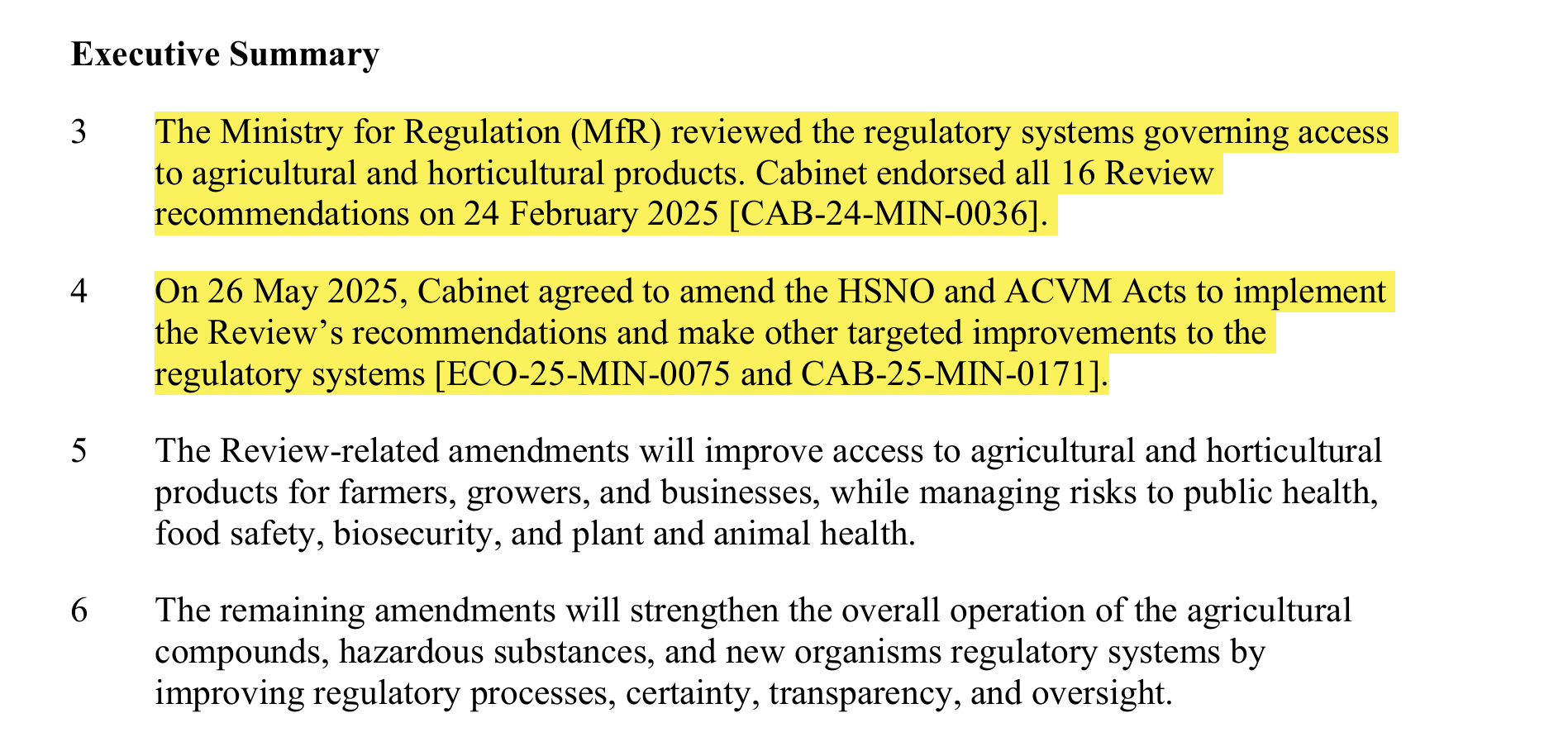
3. Grigg & Hoggard’s claim that ‘risk will be managed’ was not undertaken. Hon Nicola Grigg Minister for the Environment, and Hon Andrew Hoggard Minister for Food Safety produced an In Confidence paper (pages 11-22). It’s Executive Summary states that it will improve access … ‘while managing risks to public health, food safety, biosecurity and plant and animal health’. However, the Regulatory Impact Assessment (RIS) shows that the groups and individuals with expertise in risk assessment and human and environmental health were not invited into internal consultations. The claim that ‘risks will be managed’ lacked substance and is not evidence based.
4. Simon Upton’s Submission to the Review showed that that Review that informed the HSNO Bill was narrowly formulated and weighted to industry interests.
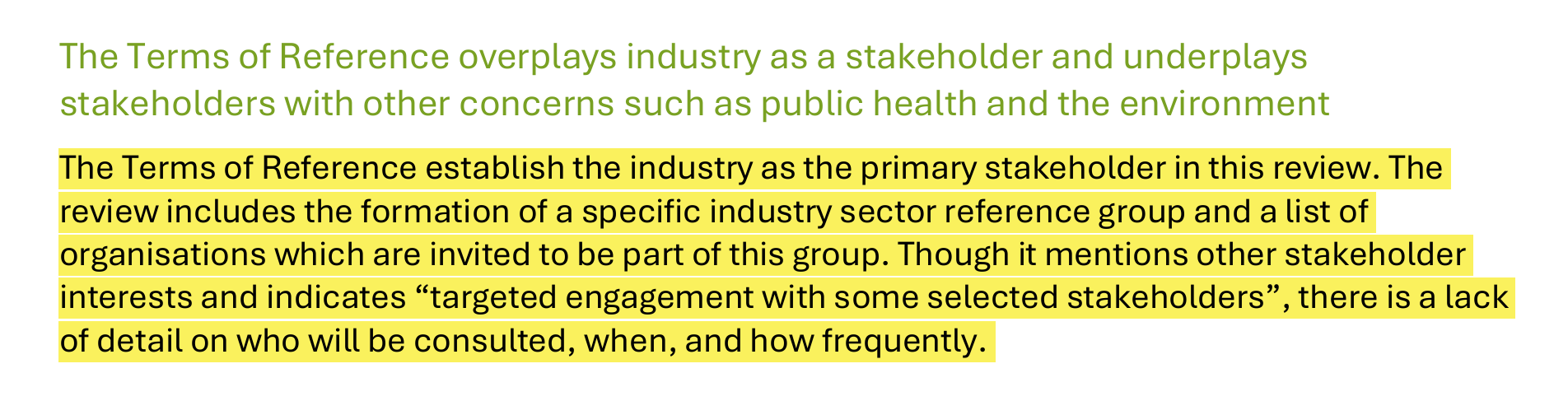
5. The Bill reflects these Stakeholders’ interests. The Bill transfers discretionary powers to Environmental Protection Authority (EPA) staff while reducing obligations to undertake risk evaluation and analyses for both hazardous substances (including pesticides) and genetically modified ‘new’ organisms (including gene edited organisms) and obligations to declare publicly what is occurring.
6. Substantial Weight placed on the perspectives of the regulated industries. Limited attention to expertise in public health, occupational disease, environmental medicine, toxicology, ecological systems and regulatory governance. This is particularly significant given the large body of international literature documenting long-term health and environmental impacts associated with hazardous substances.
a. For example, the public can observe that the lobby group named Animal and Plant Health New Zealand (APHANZ), previously known as AgCarm, was extensively consulted during the Ministry for Regulation Review and included as a targeted stakeholder in the Amendment Bill consultation. APHANZ is established to represent its industry corporate sponsors, which include many agrichemical corporations. The Parliamentary Commissioner for the Environment, was not invited into the consultation.
b. Similarly, Crown Research Institutes with extensive investments in biotechnology, who would benefit from lower regulatory standards were also invited in as ‘targeted stakeholders’ while for example, Professor Jack Heinemann, who has extensive expertise in biotechnology and regulation, was not invited in.
7. The review is premature. Given that an EPA-contracted ERM review is currently examining aspects of the risk-assessment models used to support regulatory decision-making, it is premature to substantially expand regulatory discretion and approval pathways before Parliament and the public have had the opportunity to consider EPA review findings and recommendations.
a. Any legislative reform should occur only after a modernised risk-assessment methodology has been developed, consulted upon, and independently scrutinised. Only after the ERM review has been publicly tested, and a fit-for-purpose risk-assessment methodology has been completed, should reform proposals return for further public consultation. I note that ERM has undertaken work for a range of commercial clients, including Syngenta,
b. It is not clear whether the review extends to broader questions of evidence evaluation, uncertainty analysis, epidemiological evidence, endocrine-disruption assessment, cumulative exposures, vulnerable populations, occupational disease surveillance, biomonitoring, and post-market monitoring. These issues are increasingly recognised internationally as integral components of contemporary risk governance.
c. These limitations make it inappropriate for Parliament to rely on the review as a sufficient basis for expanding regulatory discretion or reducing statutory safeguards.
8. No cost benefit analysis was undertaken. No cost-benefit analysis was undertaken of the long-term impact of granting internal powers to declare a new organism not a new organism. Cost-benefit analysis would include biosecurity of indigenous and agricultural species; the cost-benefit trade-off of losing GMO-free status.
a. The discussion of costs concerns levies and costs to chemical input suppliers and biotech developers seeking approval. This reflected the interests of the expert groups/targeted stakeholders.
b. Reduced transparency directly impacts traceability and consumer trust.
9. Bill Appears to Undermine the HSNO Act 1996. The HSNO Act was enacted because hazardous substances and new organisms can create long-term environmental, health, economic and biosecurity consequences. Parliament deliberately established a framework that requires caution, transparency and public accountability. This Bill moves in the opposite direction.
10. The Bill will likely undermine trust in New Zealand as a premium food producer. The draft Bill content carries broad implications for public transparency, consumer confidence, export markets, biosecurity and environmental oversight that has not been highlighted in the RIS.
11. The Bill gives EPA officials greater decision-making powers while providing no assurance that expertise in risk assessment keeps pace. The cumulative effect of the proposed amendments is to increase administrative discretion, reduce statutory clarity, rely more heavily on secondary legislation, and create new pathways that allow significant decisions to be made without adequate parliamentary scrutiny. At the same time there is no obligation nor required resourcing that ensures that EPA officials train to improve skills in uncertainty management, comprehensive risk assessment, toxicology, epidemiology and human and environmental health for the long-term wellbeing of New Zealand.
a. Important decisions affecting public health, environmental protection and future generations should remain subject to robust institutional scrutiny. Parliament should be cautious about concentrating authority in administrative decision-making structures without corresponding safeguards.
12. Undefined concepts promote ambiguity. In several places the Bill introduces concepts that perform important legal functions but are not clearly defined. Terms such as “risk proportionate”, “risk species”, “recognised international regulator”, “significant public interest” and “vagrant” may appear technical, but they determine how decisions will be made and who will make them. If Parliament cannot clearly define these concepts, Parliament should not delegate powers that depend upon them.
13. RIS ignores High Court finding to give officials powers to remove (new organism) gene edited organism status? I am particularly concerned about the proposal to allow certain organisms to be prescribed as not being ‘new organisms’ and the apparent discretion of the Ministry and Crown Law to synthesise what appears to be new word: ‘denewed’.
a. This creates a pathway by which organisms that would previously have been regulated under HSNO can be removed from that framework through administrative discretion rather than primary legislation. I question whether it contradicts the 2014 Sustainability Council v EPA High Court decision.
14. Reliance on overseas regulatory decisions lacks quality test. The quantity of regulators reaching a similar conclusion should not provide assurance. Overseas regulators operate within different legal frameworks, policy objectives, environmental conditions and public expectations.
a. Multiple regulatory decisions may draw upon the same studies, assumptions, guidance documents and evidential frameworks. Consequently, apparent international consensus does not necessarily represent independent confirmation of safety.
b. If New Zealand intends to rely on overseas approvals, Parliament should establish clear criteria to ensure low-bar decisions are not cherry-picked and that the public interest is served. These criteria should include consideration of scientific methodology, transparency, recency of evidence, treatment of uncertainty, conflicts of interest and relevance to New Zealand conditions.
c. The relevant question is not how many regulators agree, but whether the underlying assessment is transparent, methodologically robust, appropriately precautionary, and relevant to New Zealand conditions.
15. Substantive future powers without public safeguards. One of the most troubling aspects of the Bill is that many substantive matters are left to future regulations, notices or administrative determinations. Parliament is effectively being asked to approve a framework before the rules governing that framework have been written. This limits the ability of submitters, Members of Parliament and the public to assess the real-world consequences of the reforms.
16. The Regulatory Impact Statement (RIS) does not circle back to the purpose and principles of the HSNO Act. The RIS repeatedly emphasises efficiency, certainty and speed. These objectives do not reflect the purpose of the HSNO Act. The purpose of HSNO is to protect people and the environment while managing risk. Faster approvals do not necessarily produce better decisions.
In conclusion, I believe this Bill shifts New Zealand’s hazardous substance and new organism framework away from parliamentary accountability and toward administrative discretion. It increases reliance on powers that are undefined, delegated or deferred, while reducing the transparency and certainty that should accompany decisions with potentially long-lasting environmental and public health consequences. Parliament should not weaken safeguards unless it can clearly demonstrate that the existing safeguards are failing and that the proposed alternatives will better protect both present and future generations. In my view that case has not yet been made.
[1] Ecotoxicology and Toxicology Models Modernisation. ‘The Hazardous Substances Models Modernisation project is to deliver to the EPA modern, fit for purpose models and supporting data, to usefully strengthen our risk assessment processes. To be fully fit for purpose the EPA requires updates to a range of ecotoxicology, toxicology, and environmental fate models, data requirements, and environmental assessment.’ factors.https://www.gets.govt.nz/EPA/ExternalTenderDetails.htm?id=32645989
Of particular relevance to any legal repercussions for the EPA regarding the Covid response:
🚨 Clause 25 (new section 25C) – organisms prescribed as not new organisms (”denewed” organisms).
🚨 Clause 114 (new Part 5A) – EPA powers to determine organisms are not new organisms.
Are they introducing these to cover their tracks for the fact they didn't have the authority to make these determinations in the first place?
Change the terminology - erase the liability
Retroactively award EPA powers of determination before it is uncovered they had none.
♤♡◇♧
Stitch up to Cover Tracks!
⏰️ 🚨
Given that the petition to Release the Pfizer Contract heads to the NZ High Court 15th June.
The HSNO Act was the regulatory framework for multiple Covid pseudo-legislation in order to circumvent actual legislation.
The NZ EPA were implicit in the Advisory Task Force Groups and weaponized the consent pathway for Biotech capture.
The Secondary Legislation Act was the illegitimate offspring of the Covid-19 response.
The Royal Commission of Inquiry methodology of "scope" and "terms of reference" are the preformulaion strategies that enable censorship and litigation prevention.
Crown Institute Stakeholder Groups are The Poison Cartel
The EPA is a surveillance operative
IP and Patents are the mechanism of gate keeping profit and production
What we know of the semantics of institutionalized language:
Efficiency is code for covering tracks 👣
Make NZ Healthy = Make America Healthy Again (MAHA) which is a facade for surveillance operatives for the Poison Cartel
Legislative amendments that disband departments and overwrite Acts under urgency ensure accountability cannot be upheld retrospectively
If there is no longer an HSNO Act the judge can rule "lessons learnt"
It is surgical protectionism 🪡